Buying New in Poblenou
New Developments in Poblenou: What Buyers Should Know Before Buying New
Poblenou is one of Barcelona's most active areas for modern residential development. But a new apartment is not automatically a better apartment—and a polished sales brochure does not tell you whether the development, street, price and alternatives actually make sense for you.
Looking for a new development in Poble Nou? Start with the buyer's side of the decision.
Before the Sales Office
Finding a new development is easy. Deciding whether you should buy into it is the harder part.
This guide is not a directory of developers. I'll show you what is happening in Poblenou, where new homes are appearing and what buyers should compare before committing. The goal is not to sell you a particular project. It is to help you decide whether that project deserves your money.
The Developer's Sales Team
“Here's why you should buy this development.”
Their job is to explain the project, finishes, amenities and available homes—and ultimately to sell the developer's property.
Your Side of the Table
“Let's decide whether you should buy this development at all.”
That means comparing the location, price premium, orientation, contract, surrounding streets, competing developments and resale alternatives before you commit. Those are different questions.
Why Here?
Poblenou has something much of central Barcelona does not: room to keep changing.
Barcelona is a dense, mature city. In many established neighborhoods, genuinely new residential development is difficult simply because there is very little land left to transform. Poblenou is different.
The Starting Point
An industrial neighborhood left behind a different urban fabric.
Poblenou was historically one of Barcelona's major industrial areas. Factories, workshops, warehouses and large parcels of land created a physical structure very different from the tightly developed residential blocks of much of the older city.
As industrial uses declined or moved elsewhere, some of those sites became candidates for offices, public space, housing and mixed-use redevelopment.
The Location
Buyers get a combination Barcelona struggles to reproduce elsewhere.
Poblenou combines access to the Mediterranean with relatively modern streets, employment centers, public transport and straightforward connections back toward central Barcelona.
For many international buyers, that means a choice between traditional Barcelona character and a newer, more contemporary way of living without necessarily leaving the city.
If you're still deciding whether the neighborhood itself suits you, read my complete Poblenou neighborhood guide .
The Transformation
Poblenou is not a finished regeneration story.
New offices, housing, public spaces and the reuse of former industrial sites have been reshaping this part of Barcelona for years—and different streets are at very different stages of that process.
That matters enormously when buying new construction. You are not only buying the apartment you can see. You are also buying into what surrounds it now—and what may surround it later.
Location Before Brochure
There isn't one “Poblenou new-build market.” A few streets can change the proposition completely.
A development near the established heart of Poblenou, one surrounded by offices and construction, and another toward Barcelona's eastern edge can all appear in the same online search. They are not interchangeable places to live.
01
Established Poblenou
Around Rambla del Poblenou and the established residential core.
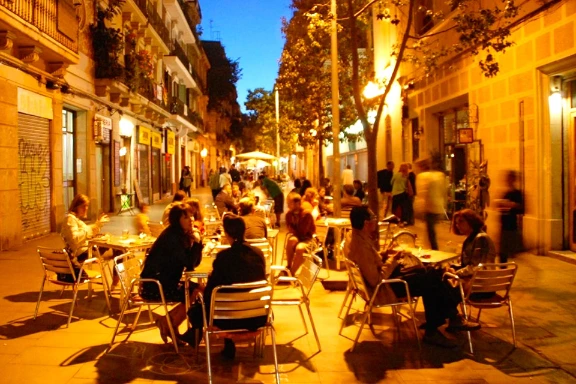
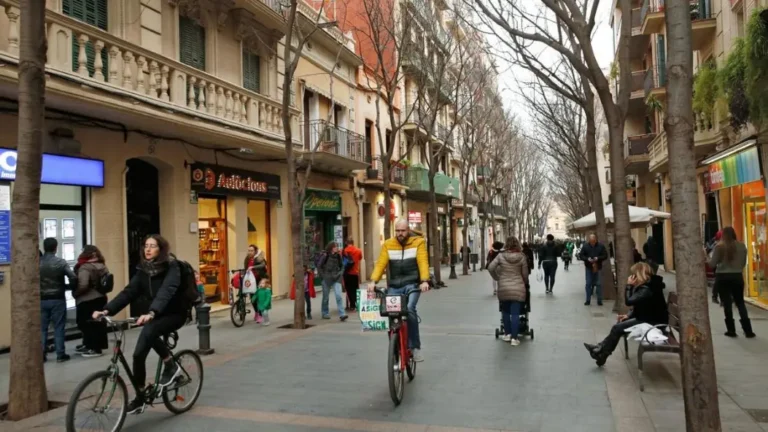
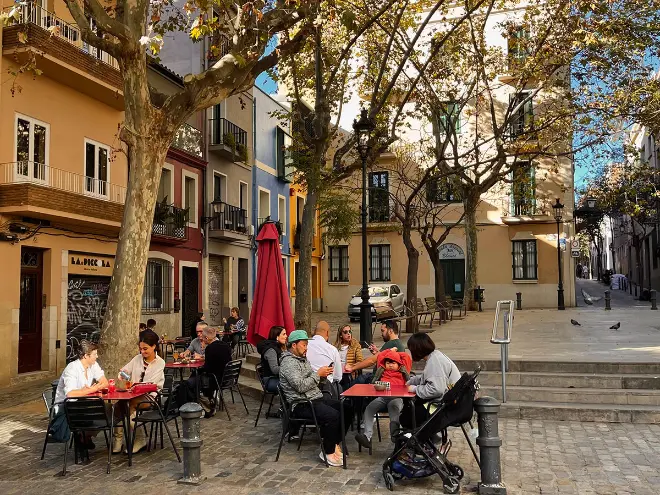
This is the Poblenou many people imagine when they say they want to live here: local shops, restaurants, established residential streets and an easy route toward the beach.
Genuine new-build opportunities can be more limited because much of the urban fabric already exists. When something new does appear, the surrounding neighborhood may already feel considerably more settled.
For a buyer, that can reduce some of the uncertainty that comes with purchasing in an area still undergoing major change.
02
Transformation Zone
Former industrial streets around the wider 22@ regeneration area.
This is where the contrast between old and new can be most obvious: converted industrial buildings, offices, construction, empty or changing parcels, older housing and brand-new residential projects can sit surprisingly close together.
The opportunity is obvious. You may be buying into a part of Barcelona that continues to improve around you.
But that also creates more questions. What will be built opposite? Is the street residential after office hours? How much construction is still likely nearby? What does the walk home actually feel like today?
03
Toward Glòries
Excellent connectivity—but a different urban experience.
As you move toward Plaça de les Glòries and the western side of the wider Poblenou transformation area, the city becomes more metropolitan: major roads, offices, cultural buildings, transport connections and newer urban projects all play a bigger role.
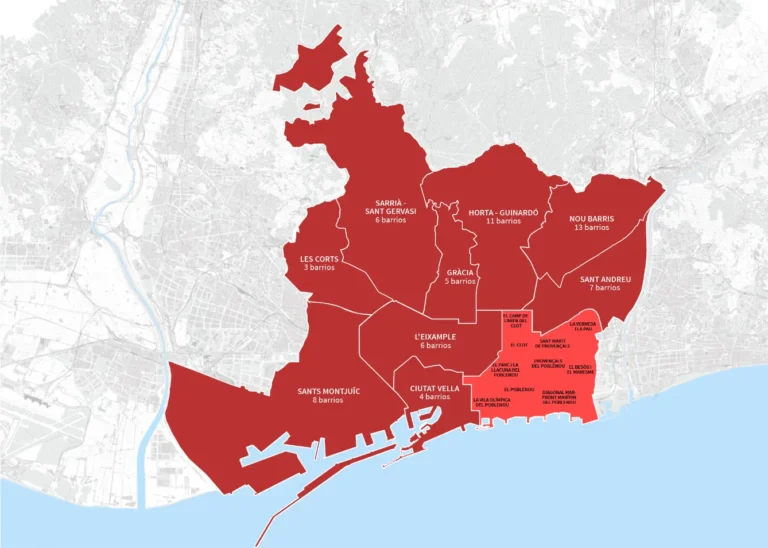
Some developments marketed through the Poblenou story may actually sit in neighboring areas such as El Parc i la Llacuna del Poblenou rather than El Poblenou proper.
That is not necessarily worse. It is simply a different proposition—and one I would evaluate on its own merits.
04
Toward Diagonal Mar
Newer Barcelona, larger developments and a more modern feel.
Continue east and you begin moving toward Diagonal Mar, the Front Marítim and Barcelona's Besòs side. Here the housing stock, street scale and style of development can feel much newer than traditional Poblenou.
Again, these are not all technically the same neighborhood. But buyers searching online for “new developments in Poblenou” will often encounter projects across this wider part of Sant Martí.
If modern construction, lifts, terraces, parking and communal facilities matter more to you than old Barcelona character, that wider search may actually be useful.
Marketing Question
“Is this development in Poblenou?”
Useful as a starting point—but the neighborhood name alone tells you remarkably little about noise, transport, street life, surrounding buildings or what may be built next door.
Buyer Question
“What exactly am I buying into at this address?”
That is the question I care about: the block, orientation, surrounding land, route to transport, neighborhood life and likely direction of change.
A Market Snapshot
A few new developments in Poblenou — and what I would actually look at as a buyer.
These are examples, not a live inventory feed. Availability, prices and construction stages can change quickly. More importantly, I don't think choosing a development should begin by comparing glossy brochures.
Under Development
Carrer de Pujades · Poblenou
Pujades 231
Pujades 231 is a relatively small new residential project in an established part of Poblenou rather than a large master-planned complex.
That distinction matters. A smaller development can offer a very different ownership experience from a large building with extensive communal facilities—and the surrounding neighborhood already exists for you to inspect.
Planned Handover 2027
Passatge de Colomer · Poblenou
Lux Poblenou
This is a completely different product: a small collection of large contemporary townhouses with private gardens, pools, roof terraces, lifts and parking.
It demonstrates why a single “Poblenou new-build price” is almost meaningless. A compact apartment and a large private house-style property may technically sit in the same new-construction search while targeting entirely different buyers.
Completed 2026
Carrer de Ramon Turró · Poblenou
Ramón Turró 290
Completed in early 2026, Ramón Turró 290 gives buyers something particularly useful: the opportunity to evaluate a recently completed new development as a real building, rather than relying primarily on plans and computer-generated images.
You can assess the finished common areas, actual light, street relationship, materials and how the completed building sits in its surroundings.
New Build vs Resale
New is different. It isn't automatically better.
Poblenou makes this comparison especially interesting because modern developments sit alongside older apartments, converted industrial buildings and renovated homes with qualities that new construction does not always reproduce. The right comparison is not “new or old?” It is “what does my budget buy me in each?”
Character & Space
Contemporary efficiency versus things that are difficult to manufacture again.
New Build
Clean lines, efficient layouts and fewer surprises.
New homes typically prioritize modern kitchens, bathrooms, insulation, lifts and efficient use of space. Everything begins life together, which can make the ownership experience simpler.
Resale
Ceiling height, texture and architectural character.
Older Poblenou can offer high ceilings, original details, unusual layouts, industrial character or renovated homes with a sense of place that a new development may not have.
Light & Outdoor Space
A terrace on the floor plan is only valuable if you will actually want to use it.
New Build
Terraces and larger windows are often part of the proposition.
Many newer projects place greater emphasis on balconies, terraces and natural light. Some also offer communal roof terraces, pools or landscaped spaces.
Resale
The apartment already tells you exactly how the light behaves.
In an existing home, we can stand inside it at different times of day and see the real orientation, outlook and relationship with neighboring buildings.
Maintenance & Efficiency
New construction usually starts with a practical advantage.
New Build
Better insulation, newer systems and less immediate work.
Modern building standards can mean improved energy performance, thermal insulation, sound insulation and more efficient heating or cooling systems.
Resale
Condition can range from excellent to “what exactly happened here?”
A properly renovated resale apartment can compete very well, but the building itself still matters: roof, façade, lift, common areas, plumbing and future community works can all affect the true cost of ownership.
Location
Resale sometimes buys you the mature neighborhood that new construction cannot.
New Build
More supply often appears where the city is still changing.
That can mean excellent long-term potential, but it can also mean construction, offices, undeveloped parcels or a street that does not yet feel fully residential.
Resale
Established streets come with fewer questions about daily life.
Around the established Poblenou core, shops, cafés, transport routes and neighborhood patterns are already visible. You can judge the place as it exists rather than imagining what it may become.
The Price Premium
The question isn't whether new construction costs more. It's whether the extra money buys something you actually value.
New Build
Part of the price is the certainty and convenience of new.
Buyers may reasonably pay more for modern systems, warranties, energy efficiency, terraces, parking, amenities or simply not having to renovate.
Resale
The same budget may buy more space, a stronger street or more character.
A well-chosen resale property can sometimes redirect the “new-build premium” into square meters, location or architectural quality instead.
The Money
The asking price is only the first number I want a buyer to understand.
New-build and resale properties are taxed differently in Catalonia, and an off-plan purchase can also require money at several points before you receive the keys. So I want to compare total cash required—not merely the number printed on the listing.
New Build vs Resale
The tax comparison changes as the resale price rises.
Normal First Sale of a New Home
New construction
10%
Value Added Tax
(IVA in Spanish)
(Actos Jurídicos Documentados, usually shortened to AJD)
For the normal first sale of a newly built home by the developer, the general Value Added Tax rate is 10%. When the VAT-taxed purchase is completed in a public deed, Catalonia generally also applies 1.5% Stamp Duty.
In other words, for a typical new-build purchase, the purchase price itself does not move through higher VAT bands simply because the apartment costs more.
General Resale Property Scale
Existing homes
Resale homes normally pay Property Transfer Tax (Impuesto sobre Transmisiones Patrimoniales, usually shortened to ITP) instead of Value Added Tax.
These are the general Catalan rates. Reduced or special rates can apply in qualifying circumstances, so the individual buyer and transaction still need to be checked.
The Other Difference
With an off-plan purchase, your money may leave your account long before you receive the keys.
Developers set their own contractual payment schedules, so I would never assume one standard percentage structure. But the cash-flow pattern often looks very different from buying an existing apartment that is ready to complete.
01
Initial Commitment
Reservation
A developer may ask for a reservation payment to remove a particular property from the market while the transaction moves toward the formal purchase contract.
Before paying, I want to understand exactly what the reservation commits you to, when it is refundable and what happens if you decide not to continue.
02
The Main Contract
Private purchase agreement
This is where the purchase normally becomes substantially more serious. The contract should set out the property, price, payment schedule, expected delivery and the obligations of both buyer and developer.
At this stage I care much more about the contract language and buyer protections than the sales brochure.
03
Before Completion
Construction-stage payments
Depending on the development, additional installments may become due while construction is progressing. The exact amounts and timing should come from the contract, not from assumptions about what developers “normally” do.
This means a buyer needs enough liquidity to satisfy the agreed schedule before the final mortgage funds are necessarily available.
04
The Finish Line
Completion and the public deed
When the property is ready and the required conditions for completion have been met, the outstanding purchase balance is normally settled and ownership is formalized in the public deed—the escritura.
This is also when financing, final documentation, the condition of the completed home and the handover process all converge.