From the BHH Journal
Notes on buying property and living well in Barcelona.
Edition 009
Neighbourhood Edition
July 2026
Barcelona Neighborhood Guide · El Raval
Living and Buying Property in El Raval.
Culture, complexity and opportunity that changes street by street.
El Raval is one of central Barcelona’s most layered neighborhoods: creative, multicultural, intensely urban and still rough around certain edges. It can offer character, walkability and more accessible entry pricing than nearby prime areas—but it demands unusually careful judgment.
Here, the buying decision cannot be reduced to price per square meter. The exact block, building, orientation, noise profile and condition of the apartment often determine whether a property becomes a smart purchase or a daily frustration.
See What Living Here Really Means →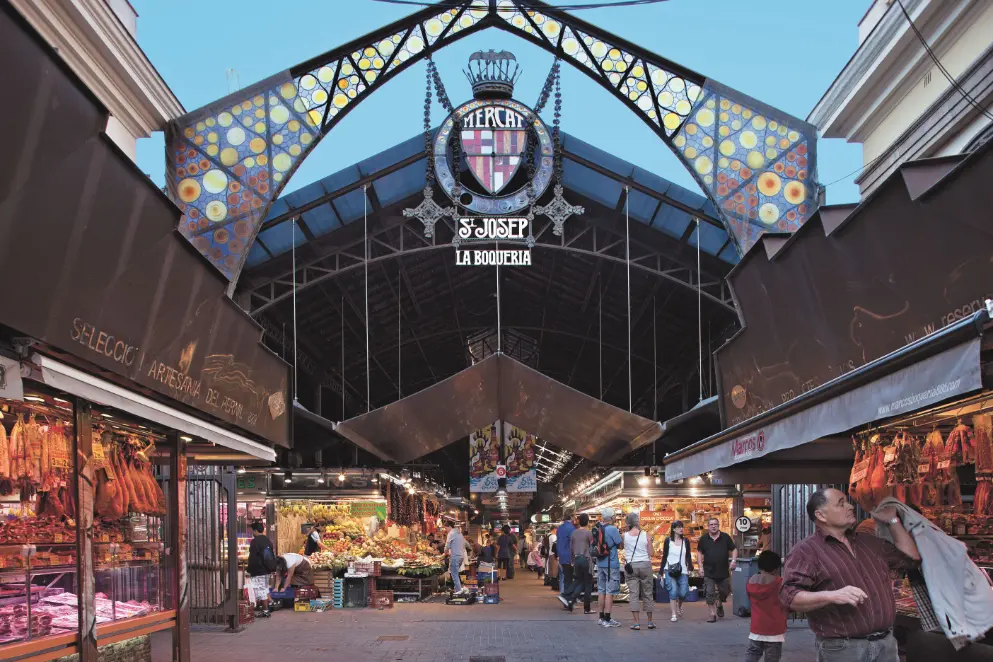
The buyer’s question
El Raval is not Barcelona on easy mode. For the right buyer, that is exactly where the opportunity begins.
The neighborhood rewards buyers who understand dense city life, evaluate buildings carefully and recognize that better value usually arrives with additional complexity.
This guide looks beyond reputation and asking prices to examine El Raval as a buyer should: street by street, building by building and without pretending its trade-offs do not exist.
Everyday El Raval
What Living Here Actually Feels Like
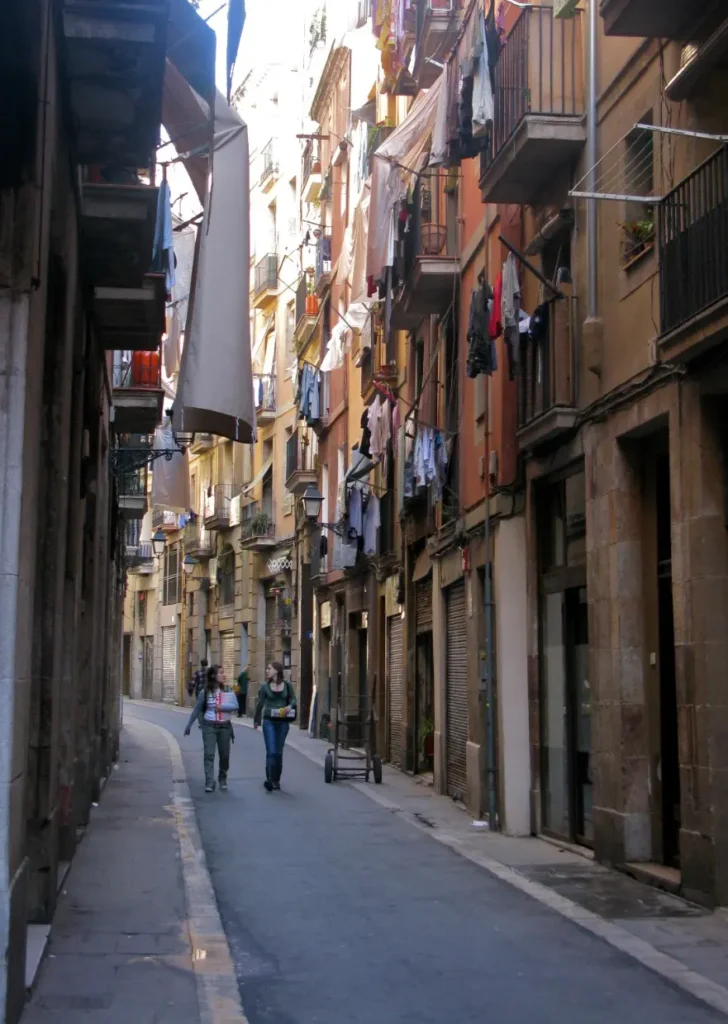
El Raval does not settle into one predictable personality. Its rhythm changes by block, by hour and sometimes by which side of the street you are standing on.
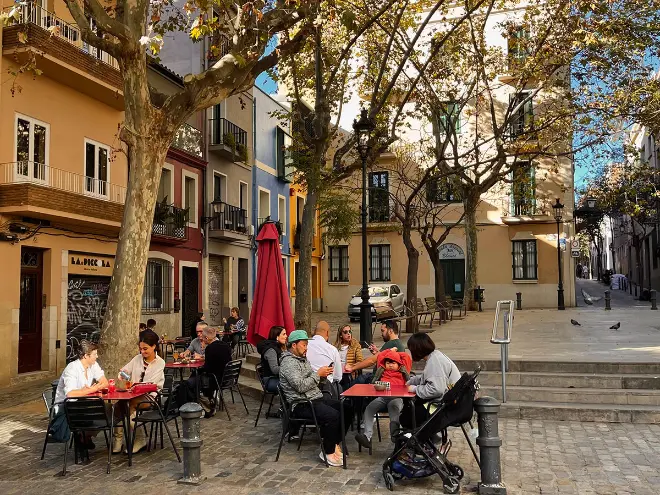
This is one of Barcelona’s densest and most culturally varied neighborhoods. Traditional bakeries, Pakistani restaurants, art institutions, local bars, skaters, tourists and long-term residents share the same compact streets. The result can feel energizing, chaotic, welcoming and exhausting—sometimes during the same afternoon.
A day in the neighborhood
8:00
The local neighborhood appears
Shutters rise, delivery vehicles arrive and residents move through bakeries, fruit shops and neighborhood cafés. Before visitor traffic builds, parts of Raval feel surprisingly practical, familiar and community-oriented.
13:30
Food, errands and cultural traffic
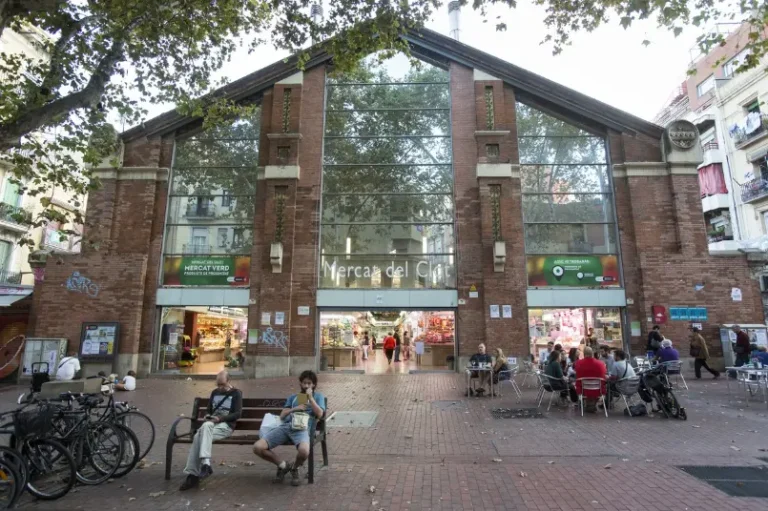
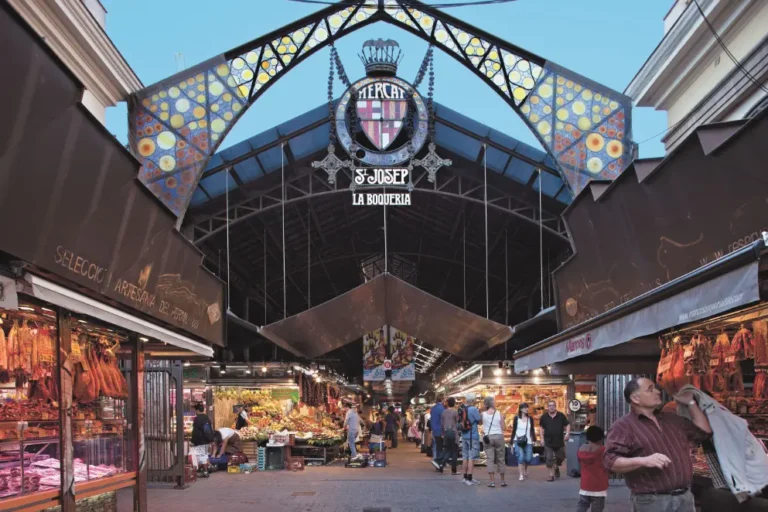
Students, workers, tourists and residents overlap around MACBA, La Boqueria, Rambla del Raval and the district’s extraordinary mix of inexpensive international restaurants. Daily needs are easy to handle on foot, although the busiest routes can become crowded.
20:30
The streets become social
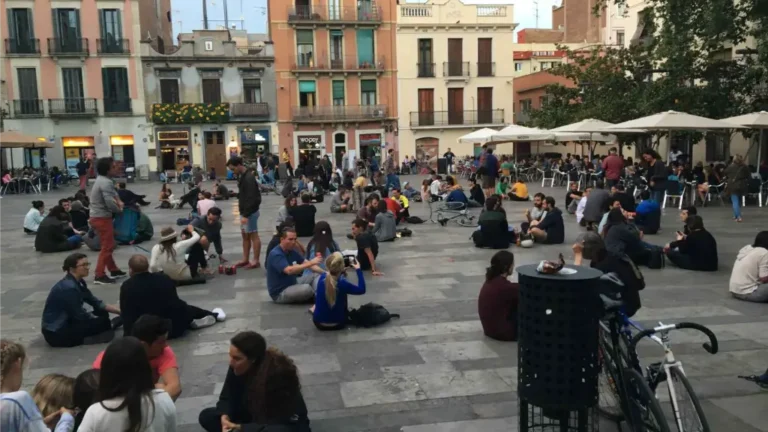
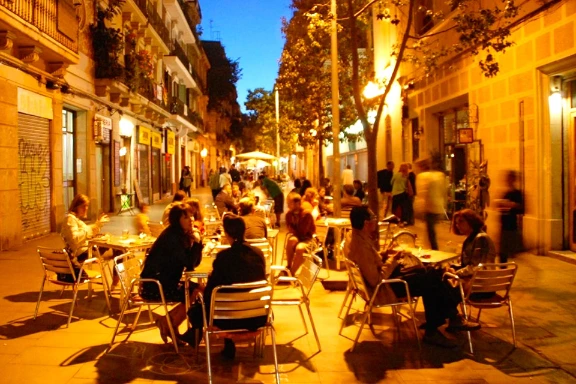
Terraces fill, dinner begins and foot traffic increases. For buyers who enjoy spontaneous urban life, this is when Raval feels most alive. For buyers craving separation between home and city, the intensity can begin to feel intrusive.
00:30
The property reveals the truth
Late-night routes, bar departures, conversations, scooters and cleaning activity expose the difference between an exciting location and a difficult sleeping environment. At this hour, glazing, floor height and bedroom orientation matter far more than decorative finishes.
The version buyers love
Barcelona without a commute
Food, culture, nightlife, transport and the historic center are all immediately accessible. Sant Antoni, the Gothic Quarter, Plaça Catalunya and the waterfront are within walking distance. A car can feel unnecessary, and ordinary evenings rarely require advance planning.
The version buyers underestimate
Very little separation from the street
Narrow streets amplify sound and place neighboring windows close together. Privacy, airflow, rubbish collection, deliveries and pedestrian movement can become part of the home itself. In Raval, the street does not always stop at the front door.
The lifestyle test
Do you enjoy urban unpredictability?
Raval works best for buyers who see density, cultural variety and constant activity as part of the attraction. If you need polished surroundings, quiet evenings and a highly predictable residential rhythm, the neighborhood may create friction rather than excitement.
Would this energy still appeal to you on an ordinary rainy Tuesday?
El Raval street by street
Six Pockets That Feel Surprisingly Different
In El Raval, the neighborhood name tells you very little about the experience outside a particular front door. The block is the real location.
Two apartments five minutes apart can offer completely different levels of light, noise, comfort and street activity.
Northern edge
MACBA, CCCB & Universitat
The upper section of Raval feels strongly connected to Plaça Catalunya, Universitat and the city center. Cultural institutions, students, skaters, cafés and creative businesses give the area a distinctive energy.
It can feel more open than deeper parts of the district, but activity around major cultural spaces creates its own sound and pedestrian patterns.
Look for Upper floors, usable daylight and bedrooms positioned away from gathering points.
Sant Antoni edge
Ronda Sant Antoni & Joaquín Costa
This side of Raval benefits from immediate access to Sant Antoni, Eixample and Universitat. It often appeals to buyers who want Raval’s character while remaining connected to a more orderly residential environment.
Joaquín Costa and nearby routes can be extremely social, however. Restaurants, bars and late pedestrian movement make exact positioning more important than proximity alone.
Look for Side-street positioning, effective glazing and a bedroom that does not face the busiest route.
Central spine
Rambla del Raval
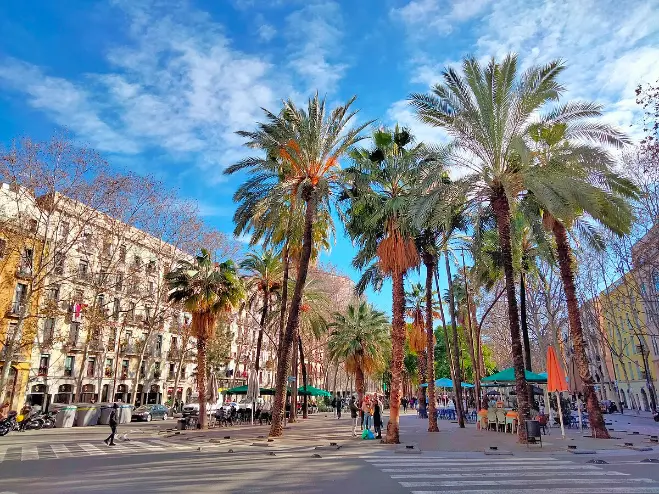
Rambla del Raval is broad, recognizable and intensely social. Its terraces, restaurants, palms and Botero cat create one of the neighborhood’s most distinctive public spaces.
The openness can improve outlook and daylight compared with narrow lanes, but buyers should expect continuous foot traffic, deliveries, terraces and activity extending into the evening.
Look for Floor height, balcony usability, bedroom orientation and what sits directly beneath the apartment.
Cultural south
Filmoteca & Plaça Salvador Seguí
The Filmoteca brought a major cultural anchor to this part of Raval. Cinemas, cafés and community life sit alongside older housing, narrow streets and a more visibly complex urban environment.
Certain buyers appreciate its authenticity and central value. Others may find the surrounding street atmosphere less comfortable than the northern or Sant Antoni-facing sections.
Look for The route home after dark, building access, entrance visibility and activity immediately beside the doorway.
Historic pocket
Sant Pau del Camp & the Poble-sec Edge
Around the Romanesque monastery, Raval reveals quieter historic corners alongside dense working streets. Proximity to Paral·lel and Poble-sec improves transport access and expands the surrounding food and nightlife options.
Street quality remains uneven, and the atmosphere can shift rapidly between a peaceful pocket and a heavily used pedestrian route.
Look for Open outlooks, nearby vacant premises, evening foot traffic and the condition of adjoining buildings.
Tourist-facing edge
La Rambla & La Boqueria Side
This edge offers extraordinary centrality and immediate access to the Gothic Quarter, Plaça Catalunya and Barcelona’s best-known market. It also carries some of the district’s heaviest visitor traffic.
Buyers should distinguish between enjoying the convenience and wanting to live beside it. Deliveries, crowds, tourist-oriented businesses and opportunistic theft require more attention here.
Look for Secure entrances, interior quiet, service access and how the block behaves before and after market hours.
The Raval street test
What to inspect before you fall in love with the apartment
Stand outside long enough to understand how the block actually works. A quick arrival with an agent rarely reveals the full residential environment.
- Terraces and licensed opening hours nearby
- Loading bays and early-morning deliveries
- Rubbish and recycling collection points
- Vacant or frequently changing commercial units
- Lighting and visibility around the entrance
- The real route from the nearest metro stop
- Distance between windows across the street
- Activity beneath the bedroom rather than the salon
Safety and residential comfort
Is El Raval Safe? Ask a More Useful Question
“Safe” is too broad to describe how living in El Raval actually feels. Buyers need to separate personal danger, opportunistic theft, street comfort and building security.
Barcelona is not a city where most residents organize daily life around fear of violent crime. In Raval, the more common concerns are pickpocketing, distraction theft, uncomfortable street activity, noise and inconsistent building access. These issues are real, but they are not the same thing.
Personal safety
Will I feel physically threatened?
Most daily activity in Raval is ordinary city life: residents, families, workers, students, visitors and local businesses sharing dense public space. However, some streets can feel more intense late at night, particularly when they are quiet, poorly lit or dominated by activity a buyer finds uncomfortable.
Opportunistic theft
Is my phone or wallet exposed?
Crowds, tourism and narrow streets create opportunities for pickpocketing and distraction theft. La Rambla, La Boqueria, transport links and busy nightlife routes deserve additional awareness. The risk is generally about attention and opportunity—not confrontation.
Street comfort
Will I enjoy returning home here?
A route can be technically safe while still feeling unpleasant to a particular buyer. Lighting, cleanliness, groups gathering near the entrance and late-night commercial activity all affect whether the journey home feels comfortable.
Residential security
Does the building protect the home?
A secure exterior door, controlled access, working intercom and well-maintained communal areas matter. Ground-floor commercial units and frequent visitor movement can also affect who enters the building and how private the residential space feels.
Audit the same street more than once
Three Visits Reveal Three Different Neighborhoods
A property viewing usually captures the easiest version of the street. Return independently and observe how the surroundings change.
10:00
Morning function
Check deliveries, rubbish collection, shutters, school routes and whether the entrance remains clear during the working morning.
20:30
Evening transition
Watch terraces fill, businesses change shifts and pedestrian movement increase. This is often the most representative time for everyday residential life.
00:30
Late-night reality
Walk from the metro, approach the entrance naturally and listen beneath the apartment. Ask yourself whether the route feels acceptable as a regular habit.
Building-security review
What to inspect at the front door
- Does the exterior door close and lock automatically?
- Can visitors enter without residents identifying them?
- Are mailboxes and communal areas properly maintained?
- Is the entrance visible from occupied homes or businesses?
- Do commercial premises share residential access?
- Are balconies and windows easily accessible from nearby structures?
Emergency information: call 112 for an immediate emergency in Catalonia. Reports of theft or other crimes can be initiated through the Mossos d’Esquadra crime-reporting information .
Homes and historic buildings
Character Is Easy to See. Building Risk Is Not.
In El Raval, the apartment is only one part of the purchase. The communal structure, access, maintenance history and immediate surroundings can matter just as much as the interior.
Traditional stock
Historic walk-ups
Expect narrow staircases, internal patios, traditional beams, balconies and layouts shaped by buildings much older than modern expectations. A lift may be absent or practically impossible to add.
Renovated stock
Character with modern finishes
Exposed brick, restored beams and decorative floors photograph beautifully. The real question is whether the renovation also improved electrics, plumbing, ventilation and sound insulation.
Creative stock
Lofts and unusual conversions
Former workshops and unconventional spaces can offer volume and personality. Buyers must confirm that the registered use, habitability and completed alterations are consistent with the home being sold.
Qualities renovation cannot easily create
Buy the Fundamentals Before You Buy the Finish
Paint, kitchens and bathrooms can be changed. The following qualities are much harder—or impossible—to correct after purchase.
Natural light
Narrow streets and compact patios can leave homes dependent on artificial lighting throughout the day. Turn every lamp off and inspect the apartment’s usable daylight honestly.
Orientation and airflow
Cross-ventilation and external windows matter in Barcelona’s warmer months. An interior apartment may be quiet but can also feel enclosed, humid or difficult to ventilate.
Access and floor height
A higher floor may improve light and privacy, but four or five levels without a lift affect daily life, renovation logistics, future buyers and the property’s realistic tenant pool.
Quiet sleeping space
A rear-facing bedroom can be more valuable than an attractive street balcony. Test sound with the windows open and closed, and identify every business operating beneath or beside the home.
The building review
Documents and conditions that deserve attention
- Current building-inspection position and any identified deficiencies
- Community meeting minutes and recurring maintenance disputes
- Available communal funds, debts and approved assessments
- Façade, roof, drainage and shared plumbing condition
- Humidity, water penetration and ventilation in common areas
- The legality and documentation of previous apartment renovations
- Lift condition—or whether buyers are incorrectly assuming one can be added
- Current tenancy, occupancy and the seller’s ability to deliver the property as agreed
A beautiful renovation is not proof of a legally clean property
Open kitchens, added bathrooms, enclosed balconies, subdivided rooms and converted commercial spaces may require permits or changes to registered information. The physical apartment, land-registry description and cadastral information should be reviewed for consistency.
This is especially important when buying an unusual space or an apartment marketed primarily around its design. Appropriate legal and technical professionals should verify the property before the buyer commits under a binding contract.
Investing in El Raval
The investment case
Central Demand Does Not Automatically Create a Good Investment
El Raval can offer a lower entry point than some neighboring central areas—but the discount usually exists for a reason.
Rental demand, walkability and cultural relevance support the investment argument. Against that, buyers must account for regulated rents, older buildings, maintenance exposure, tenant fit, street perception and future resale. The cheapest apartment is rarely the strongest asset.
The central thesis
In El Raval, livability is not separate from investment performance. It is what protects it.
Homes with better daylight, quieter bedrooms, sensible access and healthier buildings tend to appeal to a broader tenant and resale market.
An apartment that only works because it is cheap may remain cheap for the same reasons when the owner eventually wants to sell.
Official rental context · January–March 2026
What the Ciutat Vella Data Actually Tells Us
Generalitat data provides useful district context, but these figures should not be treated as the expected rent for a particular Raval apartment.
€1,011
Average monthly registered rent in Ciutat Vella
€18.41
Average registered monthly rent per square meter
61 m²
Average contracted home size in the district
Rounded from official Generalitat rental-contract statistics for Ciutat Vella, January–March 2026. El Raval is only one neighborhood within the district. See the official Barcelona district and neighborhood rental data .
Underwrite the complete asset
Four Numbers the Listing Usually Leaves Out
A credible return calculation needs more than purchase price and optimistic monthly rent.
True acquisition cost
Include transfer taxes, notary and registration expenses, legal and technical review, financing costs and buyer-side professional fees. Returns should be calculated against total capital invested.
Building exposure
A future façade, roof, lift or structural assessment can consume years of expected return. Review communal accounts, inspection information and approved or anticipated extraordinary contributions.
Legal achievable rent
Do not underwrite from the highest advertised comparable. Barcelona is within a regulated rental market, and the lawful rent may depend on the prior contract, owner status, reference index and property-specific circumstances.
Operating and exit risk
Allow for vacancy, management, insurance, repairs, non-resident tax treatment where applicable and realistic resale costs. Also ask how many future buyers will accept the same street, stairs and building.
Rental strategy
Build the plan around legal residential demand
Long-term residential rental
Central positioning can attract residents who value walkability and city access. The property still needs to compete on light, sound, condition and practical layout, not merely location.
Genuine temporary rental
A temporary contract requires a legitimate temporary purpose and appropriate documentation. It should not be treated as an automatic method for avoiding residential-rental rules.
Personal use with future flexibility
Some buyers prioritize a Barcelona base first and rental income second. In that case, select a home that you would willingly occupy yourself and confirm the legal and tax implications before renting it.
Regulatory reality · July 2026
Do Not Build the Purchase Around Tourist-Rental Assumptions
Barcelona is within Catalonia’s regulated residential-rental framework, and tourist accommodation requires specific authorization. A listing, seller or agent describing a property as “ideal for Airbnb” does not establish a lawful tourist use.
Any claimed tourist authorization should be verified independently, along with municipal rules, tourism registration, community restrictions and the authorization’s property-specific status. See the Generalitat’s official information on tourist-use housing and residential rent limitations .
Because rental, housing and tax rules can change, buyers should obtain property-specific legal and tax advice before relying on projected income.
Investing in El Raval
Investing in El Raval

Buyer fit
Who El Raval Rewards—and Who It Wears Down
El Raval is not a compromise neighborhood for everyone. It is a strong match for a narrower group of buyers who actively value what its intensity gives them.
Do you want the neighborhood itself to be part of the experience—or merely the address around your apartment?
Strong fit
Experienced urban buyers
Buyers accustomed to dense neighborhoods generally understand Raval more quickly. They know that activity, mixed uses, noise and visible social complexity are normal parts of central-city life.
They are also more likely to evaluate the exact block and building rather than accepting a broad neighborhood reputation.
Strong fit
Creative and culturally curious residents
Raval appeals to people who genuinely use the city around them: galleries, independent cinemas, inexpensive international food, music, cafés and public cultural spaces.
For these buyers, diversity and unpredictability are not inconveniences. They are part of what makes the neighborhood feel alive and distinctive.
Possible fit
Value-conscious central buyers
Buyers priced out of more polished central neighborhoods may find comparatively accessible opportunities in Raval. That does not mean they should accept every compromise to secure the postcode.
The purchase works best when the lower entry price leaves enough capacity for proper due diligence, renovation and future building costs.
Selective fit
Patient residential investors
Investors who prioritize legal residential demand and long-term asset quality may find Raval interesting. Success depends on buying a genuinely livable home—not simply the apartment with the lowest advertised price per square meter.
Investors seeking effortless ownership, tourist-rental assumptions or a uniform tenant market should be considerably more cautious.
Signs Raval may fit you
The neighborhood pulls you in
- You enjoy dense, walk-everywhere city life
- Cultural diversity is an advantage, not a concern
- You use cafés, restaurants, galleries and nightlife regularly
- You are comfortable evaluating streets individually
- You prefer character over polished uniformity
- You can accept imperfections when the fundamentals work
Signs Raval may create friction
The compromises dominate
- You need consistently quiet evenings
- Clean, orderly streets strongly affect your comfort
- You want modern buildings, parking and easy lift access
- You are uncomfortable with visible urban inequality
- You expect the entire neighborhood to feel the same
- You are selecting Raval only because it appears cheaper
The tolerance test
Questions to Answer Before You Begin Viewing
The more honestly you answer these questions, the less likely you are to confuse an exciting weekend with a sustainable daily life.
Would I still enjoy the street after the novelty disappears?
How much nighttime sound can I realistically tolerate?
Would visiting friends or family feel comfortable arriving alone?
Am I accepting poor light or difficult access simply to remain central?
Would I happily walk this route home several nights each week?
If resale took longer than expected, would I still want to own the home?
The bottom line
Raval works best when the buyer actively chooses its personality—not when they merely accept it to obtain a lower price.
A strong apartment can soften some of the neighborhood’s intensity, but it cannot transform Raval into Eixample, Gràcia or Sarrià. Buyers who need that transformation should choose a neighborhood that already supports the life they want.
Buyers who genuinely value centrality, cultural depth and imperfect urban character may find something here that Barcelona’s more polished districts no longer offer.
Compare nearby neighborhoods
If Raval Almost Fits, Look at What Is Missing
Buyers rarely reject everything about El Raval. More often, they love its centrality, culture or value but struggle with one particular trade-off.
The best alternative depends on which part of Raval attracted you—and which part made you hesitate.
For a calmer residential rhythm
Sant Antoni
What you keep
Central positioning, excellent food, strong café culture, walkability and easy access to the old city.
What changes
A more predictable residential atmosphere, broader streets and generally easier day-to-day living—usually with higher entry pricing.
For character with Montjuïc nearby
Poble-sec
What you keep
Older housing, independent restaurants, evening energy and a less polished neighborhood personality.
What changes
Better access to Montjuïc and more clearly residential pockets, although Carrer de Blai and other nightlife routes still require careful sound assessment.
For a more historic Old Town atmosphere
Gothic Quarter
What you keep
Medieval streets, extreme centrality, historic buildings and immediate access to Barcelona’s cultural core.
What changes
A more architectural and visitor-facing atmosphere. Building complexity, poor daylight and tourism remain important concerns, often at a higher purchase price.
For creative energy with broader buyer appeal
El Born
What you keep
Historic character, nightlife, galleries, restaurants, walkability and a highly recognizable Barcelona identity.
What changes
A more established international-buyer market and proximity to Ciutadella Park, but generally less relative value and continued exposure to tourism and nighttime noise.
For centrality with greater predictability
Eixample
What you keep
Central access, walkability, restaurants, transport and the ability to live without relying heavily on a car.
What changes
Wider streets, more consistent light, larger apartments and more lifts. You exchange Raval’s raw cultural intensity for greater comfort and predictability.
A faster way to narrow the search
Choose the Trade-Off You Are Willing to Live With
No central Barcelona neighborhood offers atmosphere, space, quiet, flawless buildings and low entry pricing at the same time.
- Choose Raval if cultural variety, central value and urban intensity outweigh your need for polish.
- Choose Sant Antoni if you want central food culture with a more residential daily rhythm.
- Choose Poble-sec if you want character, evening life and access to Montjuïc.
- Choose the Gothic Quarter if historic atmosphere matters more than practical housing consistency.
- Choose El Born if you want Old Town energy with a more established lifestyle market.
- Choose Eixample if comfort, light, access and broader resale appeal matter more than rawness.
The comparison principle
Compare neighborhoods during the same part of the day.
A quiet weekday morning in Sant Antoni should not be compared with a lively Saturday night in Raval. Walk both areas during similar hours, use the same practical route and imagine the same ordinary routine.
The goal is not to find the neighborhood with the fewest flaws. It is to find the place where the trade-offs support the way you actually want to live.

The Barcelona Home Hunter verdict
Is El Raval a Good Place to Buy?
Yes—but only when the buyer understands why the property appears to offer better value.
El Raval can provide central positioning, cultural depth, historic housing and purchase opportunities that are increasingly difficult to find nearby. It can also expose buyers to poor light, nighttime noise, neglected buildings and streets that feel very different after dark.
I would not buy here simply because the price looks attractive compared with Sant Antoni, Eixample or El Born. I would buy only when the street, building and apartment are individually strong enough to justify the neighborhood’s additional complexity.
In one sentence
El Raval can reward selective buyers, but it punishes anyone who confuses a low entry price with low risk.
A better buying sequence
How I Would Evaluate a Raval Property
The process should begin outside the apartment and move inward—not begin with the renovated kitchen.
Test the street
Visit during the morning, evening and after 11:00 p.m. Walk the genuine route home and inspect what operates beneath the apartment.
Investigate the building
Review access, inspection history, community finances, humidity, communal maintenance and foreseeable extraordinary contributions.
Judge the apartment without staging
Turn off the lights, open the windows and listen. Prioritize daylight, airflow, sleeping conditions and practical access over decorative character.
Model the complete purchase
Include taxes, renovation, building exposure, lawful rental income, ongoing costs and the future resale audience before deciding what the property is worth to you.
Frank’s perspective
I like El Raval more than many property buyers expect me to.
It remains culturally layered, imperfect and genuinely lived-in at a time when parts of central Barcelona can feel increasingly polished for visitors or international wealth.
But liking the neighborhood does not mean defending every block or recommending every apartment. In Raval, local knowledge is most useful when it helps a buyer say no quickly and yes very selectively.
Independent guidance for Barcelona buyers
Considering a Property in El Raval?
I help international buyers assess the complete purchase: neighborhood fit, street conditions, building risk, apartment quality, documentation and long-term value.
If Raval is on your shortlist, we can determine which micro-locations genuinely support your goals—and whether Sant Antoni, Poble-sec, the Gothic Quarter or El Born offers a better balance.
Frank Rodgers
Founder, Barcelona Home Hunter · Barcelona-based buyer representation
Investing in El Raval
Frequently asked questions
Buying, Investing and Living in El Raval
Direct answers to the questions international buyers most often ask about El Raval’s safety, property market, rental potential and daily life.
01 Is El Raval a good place to live?
El Raval can be a rewarding place to live for people who value centrality, cultural diversity, independent restaurants, nightlife and dense urban energy. Daily errands and much of central Barcelona are easily accessible on foot.
It is less suitable for buyers seeking polished streets, predictable quiet, modern buildings or a conventional family environment. The experience depends heavily on the exact street, floor, orientation and building.
02 Is El Raval safe?
El Raval is not accurately described by a single safe-or-unsafe label. Most daily activity is ordinary urban life, while opportunistic theft, uncomfortable street activity and late-night intensity are more noticeable in certain pockets.
Buyers should assess personal safety, theft exposure, street comfort and building security separately. Walk the genuine route home during the day and after dark before committing to a property.
03 Is property cheaper in El Raval?
Some Raval properties have lower asking prices than comparable homes in Sant Antoni, Eixample or El Born. However, price differences can reflect poor light, difficult access, building condition, street perception or renovation needs.
Buyers should compare total acquisition and ownership costs—not only the advertised price per square meter. A lower purchase price is valuable only when the underlying risks are understood and acceptable.
04 Is El Raval a good property investment?
El Raval can suit investors seeking central Barcelona positioning and legal residential-rental demand. The strongest assets are generally genuinely livable homes with good light, quiet sleeping space, practical access and a healthy building.
Investment performance should be modeled using lawful achievable rent, complete purchase costs, building exposure, maintenance, vacancy, taxation and realistic resale assumptions. Central location alone does not make every property a good investment.
05 Can I use an El Raval apartment for Airbnb?
Buyers should never assume that an apartment can legally be used for short tourist stays. Tourist accommodation in Barcelona requires specific authorization and is subject to extensive regulation.
Any claimed authorization should be independently verified with appropriate legal professionals and public authorities before money is committed. Consult the Generalitat’s official information on tourist-use housing .
06 Which parts of El Raval are best for buyers?
There is no universally best section. The MACBA and Universitat side offers cultural energy and strong central access. The Sant Antoni edge can feel more connected to a residential rhythm. Rambla del Raval offers openness but considerable activity, while southern pockets can feel more complex.
The more useful question is whether the specific block, building and apartment support the buyer’s routine. Raval should be evaluated at street level rather than through broad upper-versus-lower neighborhood claims.
07 Is El Raval suitable for families?
Some urban families value Raval’s centrality, diversity and car-light lifestyle. Nevertheless, the neighborhood is not usually the first choice for families prioritizing larger homes, green space, easy parking, quiet evenings and predictable residential streets.
Families often find a more practical balance in Sant Antoni , Eixample, Gràcia or other more residential neighborhoods.
08 What should I inspect before buying in El Raval?
Inspect the street at several times, the route home, natural light, ventilation, humidity, nighttime sound, access and the businesses beneath or beside the apartment.
Building due diligence should examine inspection information, community minutes, finances, planned assessments, roof and façade condition, shared plumbing and renovation documentation. Legal and technical professionals should verify the property before a binding purchase commitment.
The final principle
In El Raval, a smart purchase begins outside the apartment.
The street, route home, building, daylight and sleeping environment should all work before the buyer assigns value to exposed beams, decorative floors or a renovated kitchen.
Buy the property only when the complete residential experience supports the price.